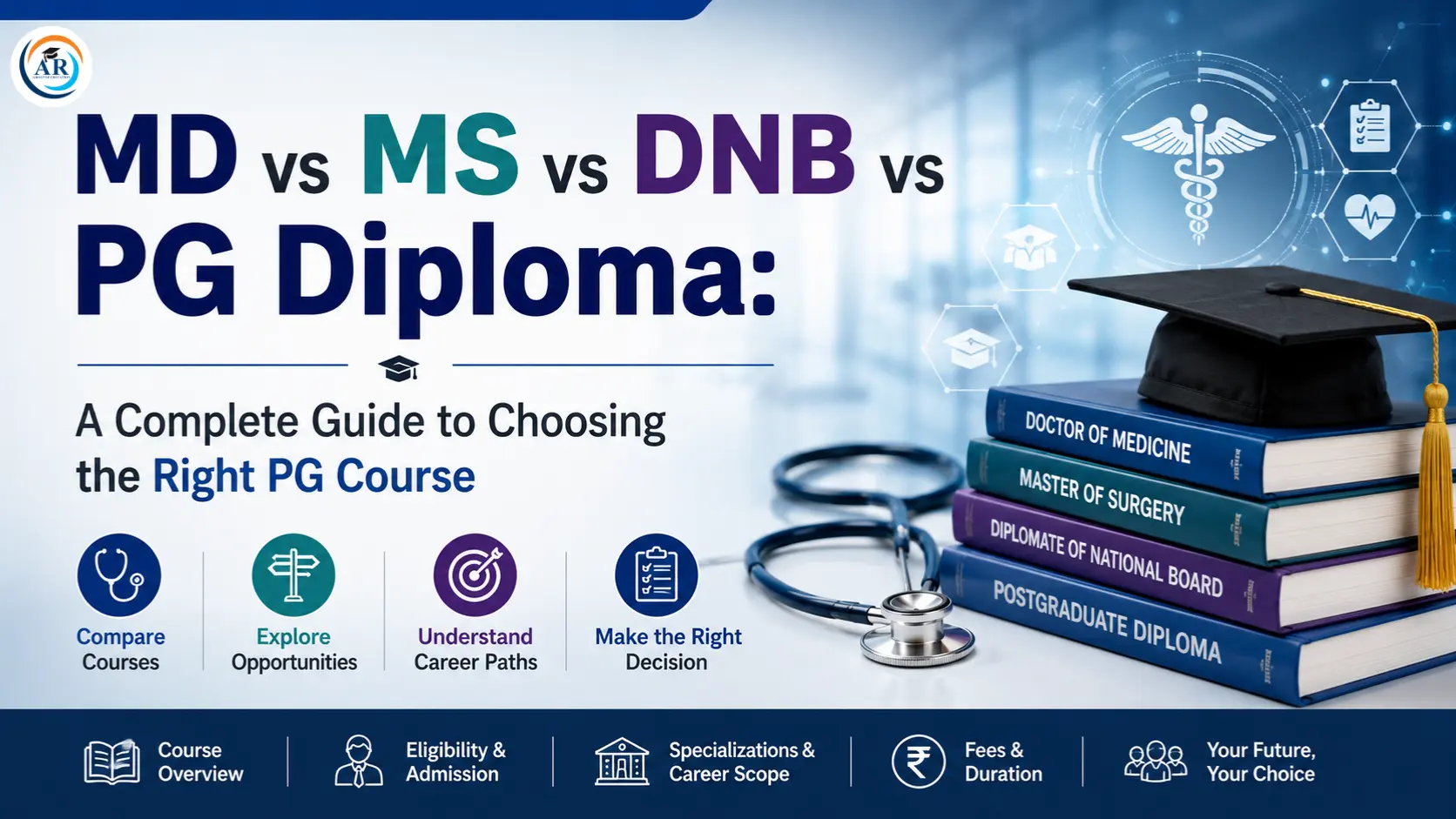
Choosing a postgraduate course after completing MBBS is an important career decision for medical graduates. PG specialization can directly impact your clinical exposure, career opportunities, earning potential, and future practice. Therefore, it is important to understand the differences between MD vs MS vs DNB vs PG Diploma before selecting a course.
In India, multiple postgraduate options are available for doctors such as MD, MS, DNB, and PG Diploma. Each course has its own duration, admission process, specialization options, recognition, and career scope. When comparing MD vs MS vs DNB vs PG Diploma, one should consider not only the popularity of the course but also their career goals, preferred specialty, NEET PG performance, and long-term plans.
Students planning MD/MS Admission in India should carefully check the applicable counselling process and eligibility requirements.
MD, MS, DNB and PG Diploma: Basic Overview
An MD (Doctor of Medicine) is a postgraduate degree generally for non-surgical and medical specialties. Students focus on diagnosis, medical management, and patient care.
The MS (Master of Surgery) is primarily for surgical specialties. This course has a major focus on operative procedures, surgical techniques, and clinical decision-making.
DNB (Diplomate of National Board) is a postgraduate medical qualification offered through accredited hospitals and institutions under the framework of the National Board of Examinations in Medical Sciences (NBEMS).
PG Diploma is a comparatively shorter postgraduate qualification that provides focused training in selected medical specialties.
Overall, to understand MD vs MS vs DNB vs PG Diploma, it is useful to compare the course structure, training environment, admission route, duration and career opportunities separately.
MD vs MS: Course Structure and Specialization Difference
MS and MS both are postgraduate medical degrees, but their primary focus is different.
MD – Medical Specializations
MD is generally performed in non-surgical branches. Popular mumps specialties include:
- MD General Medicine
- MD Pediatrics
- MD Dermatology
- MD Psychiatry
- MD Radiodiagnosis
- MD Anesthesiology
- MD Pathology
- MD Respiratory Medicine
In MD courses, students receive training on different aspects of diagnosis, clinical management, investigations and medical treatment.
MS – Surgical Specializations
The focus of MS is on surgical treatment and operative procedures. Common MS branches include:
- MS General Surgery
- MS Orthopaedics
- MS ENT
- MS Ophthalmology
- MS Obstetrics and Gynaecology
OT exposure, surgical procedures, emergency management and postoperative patient care are important components of MS training.
So while choosing MD and MS in MD vs MS vs DNB vs PG Diploma comparison, first decide whether your interest lies in medical management or surgical practice.
DNB vs MD/MS: Admission Process, Recognition and Career Scope
Both DNB and MD/MS are important pathways to postgraduate medical education. DNB programs are available at accredited hospitals and institutions, while MD/MS programs are conducted through medical colleges and universities.
Admission Process
NEET PG score/rank is generally important for admission to MD/MS and DNB courses, subject to the applicable counselling and regulatory rules.
MD/MS admission is usually done through a counselling process in government, deemed, private and other eligible medical institutions. DNB seats also follow the applicable national counselling process and eligibility requirements.
Recognition
DNB is a recognized postgraduate medical qualification. It is important to verify the recognition and eligibility of the course as per the latest official regulations at the time of admission.
MD/MS are university-based postgraduate degrees and training takes place in the academic and clinical environment of medical colleges.
Career Scope
After MD/MS, doctors can work in hospitals, medical colleges, clinics, research organizations and healthcare institutions. Career options such as hospitals, clinical practice, academics and further specialization are also available for DNB doctors, subject to applicable eligibility requirements.
While evaluating MD vs MS vs DNB vs PG Diploma, one should consider not only the name of the degree but also the institute's clinical exposure, faculty, patient load, infrastructure and demand for specialty.
PG Diploma vs MD/MS: Duration, Eligibility and Value
PG Diploma courses are traditionally shorter postgraduate programs, while MD/MS programs generally provide longer structured residency training.
Duration
MD and MS postgraduate degree programs are generally 3 years in duration after MBBS, subject to applicable regulations.
The duration of PG Diploma courses may vary depending on the specialty and prevailing regulatory framework. Therefore, the current duration of the specific course should be verified before admission.
Eligibility
For MD/MS and PG Diploma programs, an MBBS degree and applicable entrance examination/counselling requirements are generally important. Exact eligibility may depend on the specialty, institution, and current regulations.
Career Value
An MD/MS degree can be a strong option for long-term specialization and career growth. A PG Diploma can provide a shorter route, especially for candidates who wish to seek additional postgraduate training in a specific field.
However, the decision between MD vs MS vs DNB vs PG Diploma should not be based solely on duration. Course recognition, specialty, training quality, and your career objective are equally important.
MD vs MS vs DNB vs PG Diploma: Key Differences
| Feature | MD | MS | DNB | PG Diploma |
|---|---|---|---|---|
| Main Focus | Medical/Non-surgical | Surgical | Medical/Surgical specialties | Selected specialties |
| Training | Medical colleges/universities | Medical colleges/universities | Accredited institutions/hospitals | Approved institutions |
| Typical Duration | 3 years | 3 years | Generally 3 years | Varies by course |
| Admission | NEET PG + Counselling | NEET PG + Counselling | Applicable NEET PG/DNB counselling | Applicable admission route |
| Clinical Exposure | Specialty-dependent | Strong surgical exposure | Often hospital-based | Specialty-dependent |
| Career Options | Hospitals, clinics, academics | Hospitals, surgery, academics | Hospitals, practice, academics | Specialty-focused opportunities |
Which PG Course is Better for Government Jobs vs. Private Practice?
The best PG course for government jobs and private practice is not the same for everyone. Choice depends on your specialty, career objective, and recruitment rules.
Government Jobs
Specialist positions may be available in government medical colleges, hospitals, and public healthcare institutions based on postgraduate qualifications. Qualification recognition, specialty, experience, registration, and applicable government rules are important in recruitment.
Both MD/MS and DNB can be relevant postgraduate pathways, but it's important to check the eligibility criteria for a particular post against the recruitment notification.
Private Practice
Specialty selection is particularly important for private practice. There may be different types of practice opportunities in Dermatology, Pediatrics, General Medicine, Psychiatry, Radiology, Orthopedics, General Surgery, and other specialties.
If your long-term goal is to establish your own clinic, consider the course, along with the specialty's patient demand, location, competition, and required infrastructure.
How to Choose Between MD, MS, DNB, and PG Diploma?
During PG Medical Admission Counseling, students should compare their rank, preferred specialty, budget and available colleges.
To choose the right option between MD vs MS vs DNB vs PG Diploma, consider the following factors:
1. Identify Your Specialty Preference
First, decide whether you are interested in medicine, surgery, diagnostics, emergency care, or a specific specialty.
2. Compare Clinical Exposure
When choosing a course, evaluate not only the college name but also the OPD load, IPD load, emergency exposure, procedures, and hands-on training.
3. Check the Institute's Infrastructure
Hospital facilities, operating theaters, diagnostic services, ICU setup, faculty, and patient volume influence the quality of postgraduate training.
4. Consider Your Career Goal
If you want to enter academics, government service, a private hospital, or independent practice, select a specialty and course based on that goal.
5. Fees and Financial Planning
Tuition fees at government, private, deemed, and other institutions can vary significantly. Calculate course fees along with hostel, living expenses, and other institutional charges.
6. Future Super-Specialization
If you want to pursue a DM/MCh or other higher specialization in the future, first understand the eligibility pathway for your desired specialty.
Pros and Cons of MD, MS, DNB and PG Diploma
Pros:
Strong medical specialization training
Multiple clinical branches available
Hospital and academic career opportunities
Further specialization options
Cons:
competitive admission
Course duration generally 3 years
Fees may be high according to the institute.
MS
Pros:
- Strong surgical training
- Hands-on operative exposure
- Surgical career opportunities
- Scope for further specialization
Cons:
- Demanding residency
- Long working hours
- Surgical skills develop karne ke liye consistent hands-on exposure required
DNB
Pros:
- Hospital-based training environment
- Multiple specialties available
- Recognized postgraduate qualification
- Clinical exposure can depend on the patient load of the institute.
Cons:
- The training experience may vary by institution.
- The workload and academic environment may vary by hospital.
PG Diploma
Pros:
- Shorter postgraduate pathways in applicable programs
- Focused specialty training
- May be useful for specific career goals
Cons:
- Scope may be specialty-dependent compared to degree programs.
- Available specialties may be limited.
- It's important to assess value against long-term career goals.
Which One Should You Choose?
Ultimately, no single course is universally best among MD vs MS vs DNB vs PG Diploma. If you want to pursue a medicine-oriented branch, MD may be a relevant option. MS may be considered for a surgical career. DNB provides a pathway to strong hospital-based postgraduate training, while PG Diploma may be an option for focused training in specific specialties.
Evaluate your NEET PG Counselling rank, preferred specialty, budget, institute quality, clinical exposure and long-term career plans before making a final decision.
While comparing MD vs MS vs DNB vs PG Diploma, it is also important to verify the current admission rules and recognition status from official sources, as counselling policies and eligibility requirements may change over time.
How AR Group of Education Can Help?
In the postgraduate medical admission process, students may find it challenging to understand course selection, college selection, counselling strategy and available admission options. AR Group of Education can help students understand MD/MS/DNB-related admission options, shortlist suitable colleges and provide guidance for counselling decisions.
If you are confused between MD vs MS vs DNB vs PG Diploma, a better approach is to compare the options based on your NEET PG rank, preferred specialty and budget and then take a decision.
Conclusion
Choosing a PG course after MBBS is not just a decision about selecting a degree; it sets the foundation for your long-term medical career. While comparing MD vs MS vs DNB vs PG Diploma, collectively evaluate the course structure, specialty, clinical exposure, duration, recognition, fees and future career opportunities.
The right course is the one that best matches your interest, NEET PG performance, financial situation and career goals. Instead of making hasty decisions, systematically compare the available options and check the latest counselling and regulatory guidelines before making the final choice. Also MD/MS Counseling And Guidance.
FAQs
01Is NEET PG required for management quota admission?
Answer: Yes, NEET PG qualification is generally required for MD/MS admission through management quota, as per applicable rules.
02What is the difference between management quota and NRI quota?
Answer: Management quota is for eligible candidates under management seats, while NRI quota is specifically for candidates meeting the prescribed NRI criteria.
03Who is eligible to apply under NRI quota for MD/MS?
Answer: Candidates meeting the applicable NRI eligibility criteria or having an eligible NRI sponsor may apply, subject to counselling rules.
04What documents are needed for NRI quota MD/MS admission?
Answer: Common documents include NEET PG scorecard, MBBS documents, passport, NRI proof, sponsorship/relationship documents and identity proof.
Need guidance?
Expert MBBS counselling, India & Abroad
College shortlisting, fees, NEET eligibility, and documentation support.