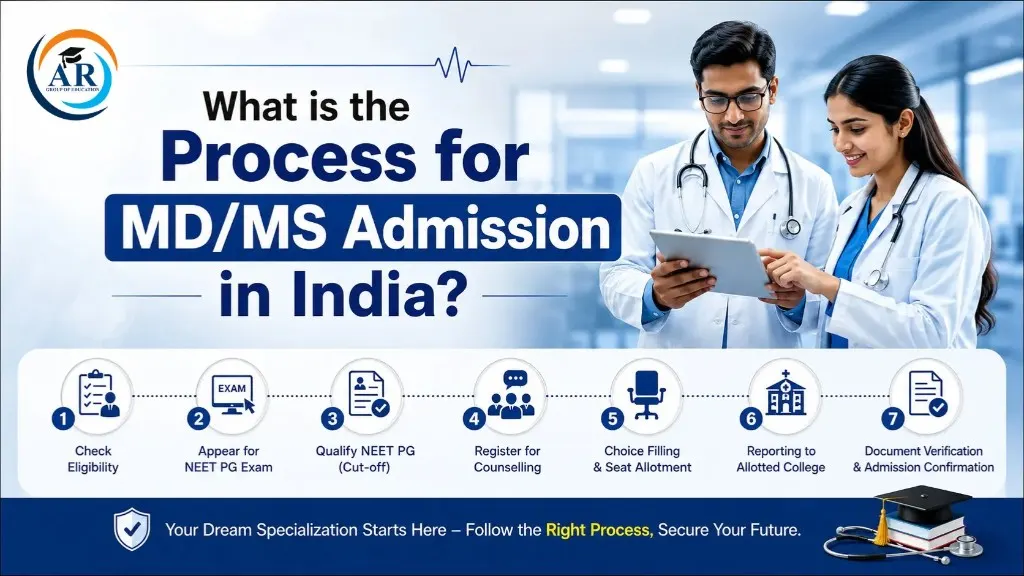
After completing MBBS, many medical graduates choose postgraduate courses such as Doctor of Medicine (MD) or Master of Surgery (MS) to specialize in their preferred field. However, the admission process involves several important stages, including entrance examination, eligibility verification, counselling, choice filling, seat allotment, and college reporting. Understanding the complete MD/MS admission process in India can help medical graduates plan their postgraduate journey more effectively and avoid mistakes during counselling. In this blog, we will explain the complete process, eligibility requirements, entrance examination, counselling procedure, documents required, and other important aspects of MD/MS admission. What is MD/MS Admission in India? MD (Doctor of Medicine) and MS (Master of Surgery) are postgraduate medical degree programmes pursued after completing MBBS. MD generally covers non-surgical clinical and para-clinical specialties, while MS focuses primarily on surgical specialties. The MD/MS admission in India process is mainly based on the candidate's performance in the National Eligibility cum Entrance Test for Postgraduate (NEET PG), followed by centralized counselling. Students who are planning to Study MBBS in India should also understand the postgraduate pathway in advance, especially if they intend to pursue specialization after completing their MBBS degree. Students can apply for MD/MS seats in government medical colleges, private medical colleges, deemed universities, and other participating institutions, depending on their eligibility and NEET PG rank. Eligibility Criteria for MD/MS Admission Before applying, candidates must fulfill the prescribed eligibility requirements. The major requirements generally include:
- The candidate must have completed an MBBS degree from a recognized medical college.
- The candidate should have completed or be eligible to complete the required internship within the prescribed timeline.
- The candidate must qualify for NEET PG as per the applicable eligibility criteria.
- The candidate should possess the required registration with the National Medical Commission (NMC) or the concerned State Medical Council.
- Candidates must satisfy the eligibility requirements specified by the counselling authority and respective institutions.
Eligibility requirements and deadlines can vary, so students should always check the latest official notification before applying. Candidates who need help understanding eligibility, colleges, fees, and admission procedures can also seek professional Medical Admission Guidance.
Step 1: Qualify for NEET PG
The first major step in the MD/MS admission in India process is qualifying for NEET PG. NEET PG is the national-level entrance examination used for admission to various postgraduate medical courses, including MD and MS. Candidates are required to appear for the examination and obtain a qualifying score and rank. Your NEET PG rank plays an important role in determining the postgraduate colleges and specialties available during counselling. A better rank generally provides access to a wider range of choices, including popular clinical specialties and reputed medical colleges.The first major step in the MD/MS admission in India process is qualifying for NEET PG. NEET PG is the national-level entrance examination used for admission to various postgraduate medical courses, including MD and MS. Candidates are required to appear for the examination and obtain a qualifying score and rank. Your NEET PG rank plays an important role in determining the postgraduate colleges and specialties available during counselling. A better rank generally provides access to a wider range of choices, including popular clinical specialties and reputed medical colleges.
Step 2: Register for NEET PG Counselling
After the NEET PG result is announced, eligible candidates need to participate in the appropriate counselling process. The Medical Counselling Committee (MCC) conducts counselling for several categories of postgraduate medical seats, including: * All India Quota (AIQ) seats * Deemed University seats * Central Universities * Certain other participating institutions State counselling authorities conduct counselling for seats under their respective state quota and other applicable categories. The NEET PG Counselling process requires candidates to carefully check registration dates, eligibility conditions, available seats, choice-filling rules, and reporting deadlines. Candidates must carefully select the counselling authority applicable to their preferred college and seat category.
Step 3: Complete Registration and Fee Payment
During counselling registration, candidates generally need to provide their personal, academic, NEET PG, and registration details. The process usually includes: 1. Creating a counselling account. 2. Entering personal and academic information. 3. Uploading the required documents. 4. Paying the applicable registration or counselling fee. 5. Paying the security deposit, wherever applicable. 6. Submitting the registration form. Candidates should check all information carefully before final submission because incorrect details may create problems during document verification or seat allotment.
Step 4: Fill MD/MS College and Course Choices
Choice filling is one of the most important stages of MD/MS admission in India. Candidates need to select their preferred: * Medical colleges * MD/MS specialties * Seat categories * Course combinations Choices should be arranged according to personal preference, NEET PG rank, previous admission trends, fee structure, location, college reputation, clinical exposure, and career goals. Candidates should avoid filling choices randomly. A well-planned preference list can improve the chances of securing a suitable seat during counselling. Students who are comparing different colleges and specialties can take Medical Admission Guidance to better understand factors such as fees, clinical exposure, college reputation, and career opportunities.
Step 5: Seat Allotment
After the choice-filling window closes, the counselling authority processes the preferences and candidate ranks to allot seats. The result may include: * College name * Course/specialty * Seat category * Reporting instructions If a candidate receives a seat, they generally have options such as accepting the seat, joining the allotted college, or participating in subsequent rounds according to the counselling rules. Candidates should carefully understand the rules related to Free Exit, Upgrade, Float, or other applicable options, as these can differ depending on the counselling authority and round.
Step 6: Report to the Allotted Medical College
After receiving a seat, candidates must report to the allotted institution within the specified deadline. At the time of reporting, the college may verify the candidate's original documents and collect the required admission fees. Failure to report within the prescribed deadline can result in cancellation of the allotted seat, depending on the applicable counselling rules. Therefore, candidates should regularly check official counselling notifications and college instructions.
Step 7: Participate in Further Counselling Rounds if Required
If a candidate does not receive a preferred seat in the first round, or wants to upgrade to another college or specialty, they may participate in subsequent counselling rounds if permitted. The counselling process may include multiple rounds, such as: * Round 1 * Round 2 * Mop-Up Round * Stray Vacancy Round The exact number and structure of rounds can vary each year and across different counselling authorities. Documents Required for MD/MS Admission During MD/MS admission in India, candidates generally need to keep the following documents ready: * NEET PG admit card * NEET PG scorecard or result * MBBS degree certificate * MBBS marksheets * Internship completion certificate * Permanent or provisional medical registration certificate * Class 10 certificate for date of birth * Valid identity proof * Recent passport-size photographs * Category certificate, if applicable * Domicile certificate, where applicable * Migration certificate, if required * Counselling registration documents * Seat allotment letter * Other documents specified by the counselling authority or college Candidates should keep both original documents and multiple photocopies ready for the admission process. MD/MS Admission Through Different Seat Categories The MD/MS admission in India process can differ depending on the type of seat. All India Quota Seats AIQ seats are generally filled through centralized counselling conducted by MCC. Candidates from different states can compete for eligible AIQ seats according to the applicable rules. State Quota Seats State quota seats are generally handled by the respective state counselling authority. Eligibility requirements, domicile rules, fees, and participating colleges may vary between states. Deemed Universities Deemed universities have their own fee structures and seat categories but participate in the centralized counselling process applicable to them. Private Medical Colleges Private colleges may have management and other applicable seat categories. Candidates should carefully check the fee structure and admission rules before selecting a college. MD vs MS: Which One Should You Choose? Choosing between MD and MS depends mainly on your preferred specialty and career plans. MD MS Doctor of Medicine Master of Surgery Primarily focuses on medical/non-surgical specialties Primarily focuses on surgical specialties Examples include MD Medicine, Pediatrics, Dermatology, Psychiatry Examples include MS General Surgery, Orthopedics, ENT Suitable for candidates interested in medical specialties Suitable for candidates interested in surgical specialties
Your decision should be based on your interest, aptitude, long-term career goals, work environment preferences, and expected career opportunities. Factors to Consider While Choosing an MD/MS College Before accepting a postgraduate seat, candidates should evaluate more than just the college name. Important factors include:
A college with strong clinical exposure can be particularly valuable for postgraduate medical training. How Does NEET PG Rank Affect MD/MS Admission? NEET PG rank is one of the most important factors influencing postgraduate seat allotment. Candidates with stronger ranks may have access to more preferred specialties and colleges, while candidates with comparatively lower ranks may need to consider a wider range of options. However, the actual closing rank can change every year depending on factors such as:
- Number of candidates
- Seat availability
- Specialty demand
- Category
- College preference
- Counselling round
- State and seat type
Therefore, previous-year cutoffs should be used only as a reference rather than a guarantee. What is the Role of Counselling in MD/MS Admission? Counselling connects eligible NEET PG candidates with available postgraduate seats. During counselling, candidates register, submit preferences, receive seat allotments, and complete admission formalities. The MD/MS admission in India journey can become easier when candidates understand the counselling rules and prepare their choices before the choice-filling window opens. Candidates should also monitor official notifications because counselling dates, eligibility conditions, seat matrices, and other rules may change. Tips for a Smooth MD/MS Admission Process Here are some useful tips for medical graduates:
- Check eligibility early: Confirm your internship and registration requirements before counselling.
- Keep documents ready: Arrange all certificates and identity documents in advance.
- Research colleges: Compare specialties, fees, clinical exposure, and other important factors.
- Prepare a preference list: Rank colleges and specialties according to your genuine priorities.
- Understand counselling rules: Carefully read the instructions before choosing or accepting a seat.
- Track deadlines: Missing registration or reporting deadlines can affect your admission.
- Check official updates: Always verify dates, seat matrices, and admission rules from the concerned counselling authority.
Conclusion The MD/MS admission in India process involves several stages, starting with NEET PG and continuing through counselling, choice filling, seat allotment, document verification, and college reporting. For medical graduates, understanding every stage can help reduce confusion and make the admission process more organized. Your NEET PG rank, preferred specialty, category, budget, and college preferences all play an important role in determining your postgraduate options. Therefore, candidates should research carefully and make informed decisions rather than choosing a college solely based on its name. For students who need guidance with postgraduate medical counselling, college selection, fee comparison, and admission planning, AR Group of Education can help candidates understand their available options and plan the next steps.
Frequently Asked Questions
01Is NEET PG required for MD/MS admission in India?
Yes. NEET PG is the primary entrance examination for admission to MD and MS postgraduate medical courses in India, subject to the applicable rules.
02Can I get MD/MS admission without NEET PG?
Generally, candidates must qualify for the applicable postgraduate medical entrance requirements. Students should check the latest official regulations before applying.
03How are MD/MS seats allotted?
Seats are allotted through counselling based on factors such as NEET PG rank, candidate preferences, seat availability, category, and applicable counselling rules.
04Can I change my specialty after getting an MD/MS seat?
Changing a specialty after admission is generally subject to the applicable university and counselling regulations. Candidates should check the specific rules before making a decision.
05Which is better, MD or MS?
Neither is universally better. MD is generally suited to candidates interested in medical specialties, while MS is primarily focused on surgical specialties. The right choice depends on your interests and career goals.
Need guidance?
Expert MBBS counselling, India & Abroad
College shortlisting, fees, NEET eligibility, and documentation support.