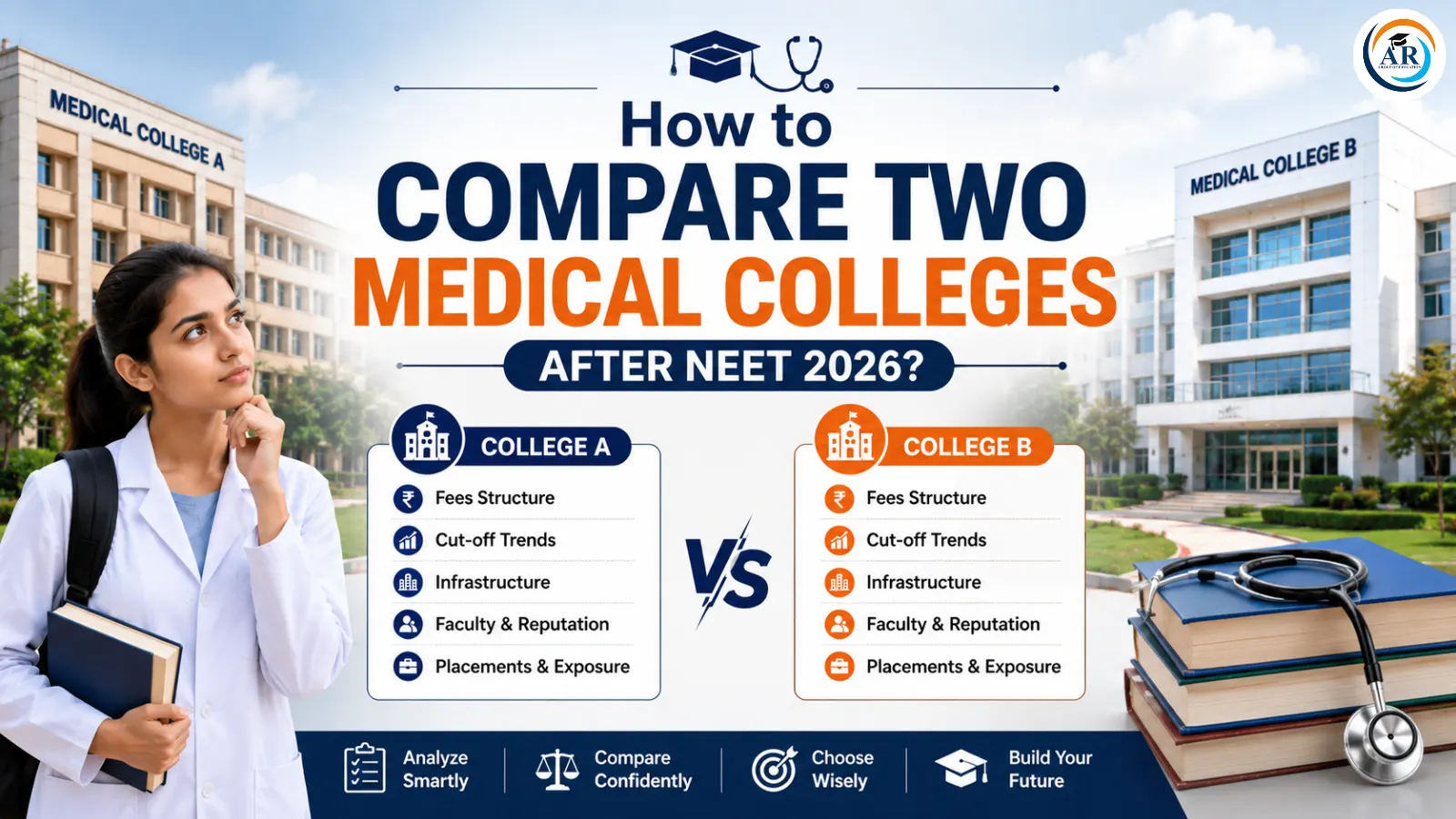
After qualifying the NEET 2026 the most important decision comes to students mind, which medical college to choose? At the time of counselling students get multiple options for the same type of colleges, where fees, location, infrastructure, hospital exposure and other facilities are different.
Making decisions only just seeing the name of college & ranking. If you have the options of two medical colleges, then it is important to compare both colleges systematically. That is why students should understand which factors should be given priority while choosing medical colleges after admission.
In this guide, we will look at step-by-step how to compare two medical colleges after NEET UG Counselling 2026 and what to check before taking the final decision.
Why Is It Important to Compare Two Medical Colleges After NEET?
MBBS is a long-term academic and professional journey. Whichever college you choose it will influence your academics, clinical exposure, internship experience and overall medical education.
If two colleges offer similar courses, the decision should not be based solely on “the college is famous” or “the fees are low”.
Comparing Two Medical Colleges After NEET helps students objectively understand which college is a better fit for their budget, career goals, and academic expectations.
Consider these factors while Comparison:
1. Check NMC Recognition and University Affiliation
Students can also research the Top Medical Colleges for MBBS to understand how their shortlisted colleges compare in terms of recognition, academics, and facilities.
It is important to verify the current status and official information of the college before MBBS admission. Do not rely solely on advertisements or third-party websites.
Compare Two Medical Colleges After NEET While doing this, check the recognition, university affiliation and course-related approvals of both the colleges side-by-side.
What to Check?
- College recognition status
- University affiliation
- MBBS course duration
- Annual intake
- Internship structure
- Current regulatory status
2. Compare MBBS Fees and Total Cost
Fees is a major factor of medical college selection, especially in the case of private medical colleges.
Students should not compare only tuition fee. Calculating total cost is a more practical approach.
What to include in Total Cost?
- Tuition fees
- Admission charges
- Hostel fees
- Security deposit
- Mess charges
- Examination fees
- Library charges
- Transportation
- Books and equipment
- Living expenses
For example, if college A has a lower tuition fee but hostel and living costs are significantly higher, then overall expenses can be close to college B.
Therefore, while choosing two medical colleges after admission, calculate the total MBBS cost and not just the annual tuition fee.
3. Priority given to Attached Teaching Hospital
MBBS education is not limited to classroom lectures. Hospital exposure is extremely important for medical students.
Check the size, departments and patient load of the teaching hospital attached to the college.
Check in to hospital premises:
- Number of beds
- OPD patient load
- IPD admissions
- Emergency services
- ICU facilities
- Operation theatres
- Major clinical departments
- Diagnostic facilities
- Availability of specialists
A college with good clinical exposure can help students understand real-world patient management better.
That is why while planning for medical colleges, the hospital should be given as much importance as the infrastructure of the college.
4. Compare Patient Footfall and Clinical Exposure
Patient exposure is a major learning factor for MBBS students.
If the hospital has regular OPD and IPD patients, students can get more opportunities to observe different diseases and clinical cases.
Compare patient footfall in the hospitals of both the colleges.
Ask These Questions:
- What is the approximate daily OPD size?
- How active is the Emergency Department?
- Are clinical postings conducted properly?
- Do students receive exposure to patient examinations?
- Are major specialties available?
- What is the practical exposure like during the internship?
When choosing medical colleges after policy, don't just look at buildings and classrooms evaluate the actual clinical learning environment, too.
5. Faculty and Academic Environment
While researching the Best Medical Colleges in India, students should also consider faculty quality and the overall academic environment rather than relying only on rankings.
Along with checking the faculty details on the college website, try to get feedback from students as well.
While comparing Faculty:
- Number of faculty members
- Teaching experience
- Department strength
- Faculty availability
- Academic support
- Mentorship system
- Practical teaching
- Internal assessment pattern
However, faculty strength shouldn't be judged solely by numbers. Teaching quality and student interaction are equally important.
6. Infrastructure and College Facilities
Students spend multiple years in medical college, so campus facilities should also be a part of decision-making.
While visiting two medical colleges after policy, please check the following facilities:
You should also check whether the facilities are properly maintained or just mentioned in the brochure only.
7. Hostel and Accommodation Facilities
If you are going out of your hometown to pursue MBBS, then the role of hostel facilities becomes even more important.
While choosing hostel clothes, don't just look at the room rent.
Check:
- Hostel fee
- Room sharing
- Mess quality
- Electricity and water supply
- Security
- Wi-Fi
- Cleanliness
- Hostel rules
- Distance from college/hospital
- Availability of separate accommodation for different batches/genders
The distance between the hostel and the college is also important because MBBS students have to attend regular classes and hospital postings.
8. Location and Connectivity
This is particularly important when planning MBBS Admission in India, as students may have to spend several years living near the college.
While preparing for Compare Two Medical Colleges After NEET, also evaluate the location from a practical perspective.
Consider:
- Nearest airport
- Railway station
- Bus connectivity
- Local transportation
- Nearby markets
- Medical shops
- Banks and ATMs
- Safety
- Cost of living
If one college is in a metro city and the other in a smaller city, then despite the fees being similar, the living expenses can be significantly different.
9. Internship Opportunities and Exposure
Internship is an important phase of compulsory professional training after MBBS. Therefore it is useful to get information about the internship structure before admission.
Check whether students get adequate exposure across major departments and whether the internship is conducted according to applicable regulations.
Internship Comparison Checklist
- Internship departments
- Clinical workload
- Hospital patient exposure
- Emergency postings
- Rural/community exposure
- Practical responsibilities
- Stipend, where applicable
- Internship-related rules
A good internship environment can help students develop clinical confidence.
10. Bond Conditions and Other Rules
Students often overlook this factor, but it should be carefully checked when making an admission decision.
Bond/service-related conditions may be applicable in different colleges or states.
Before comparing two medical colleges after NEET, verify the current bond rules, service obligations, discontinuation rules, and other financial conditions of both colleges.
Specifically Check:
- Service bond
- Bond duration
- Bond amount
- Discontinuation penalty
- Internship conditions
- Hostel rules
- Refund policy
Always verify these details from the latest official notification or college authority before paying fees.
11. Check PG and Future Career Opportunities
Many students pursue NEET-PG or other postgraduate pathways after MBBS. Therefore, the academic environment of the college can indirectly influence future preparation.
You can check:
- Academic environment
- Library facilities
- Research opportunities
- Conferences and seminars
- Student academic activities
- Alumni network
- Availability of postgraduate departments
But don't judge a college based solely on the number of PG seats. Evaluate the overall academic ecosystem.
Conclusion
After NEET 2026, choosing the right medical college requires more than checking fees or reputation. Students should compare academics, clinical exposure, hospital facilities, infrastructure, hostel, location, and future opportunities before making a decision. AR Group of Education can also help students with NEET counselling, college selection, and MBBS admission guidance.
FAQs
01How should I compare two medical colleges after NEET 2026?
Answer: Compare their fees, recognition, hospital exposure, clinical facilities, faculty, infrastructure, hostel, location, and internship opportunities.
02Is the lowest-fee medical college always the best option?
Answer: No. Fees are important, but students should also consider clinical exposure, hospital facilities, academics, and overall learning opportunities.
03Why is hospital exposure important for MBBS students?
Answer: A strong teaching hospital can provide students with better opportunities to observe patients, understand clinical cases, and develop practical skills.
04Should I talk to current students before choosing a medical college?
Answer: Yes. Current students can provide practical insights into teaching quality, hostel facilities, hospital exposure, faculty, and campus life.
05How can AR Group of Education help with medical college selection?
Answer: AR Group of Education provides guidance related to NEET counselling, medical college shortlisting, admission procedures, and MBBS admission decisions.
Need guidance?
Expert MBBS counselling, India & Abroad
College shortlisting, fees, NEET eligibility, and documentation support.